
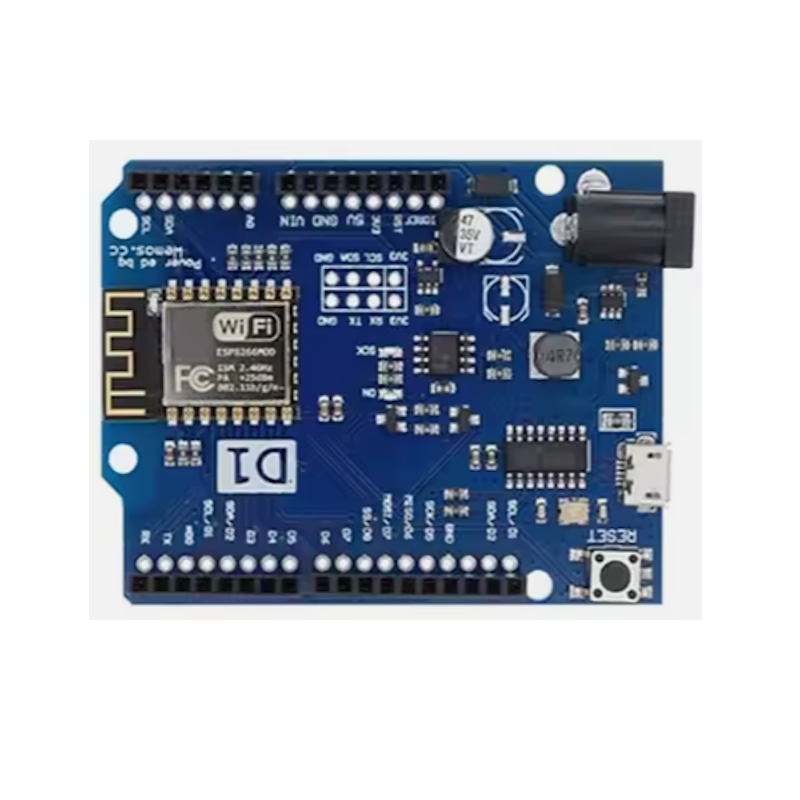

Overview: The D1 R32 ESP32 Board blends the power of the ESP-WROOM-32 dual-core Wi-Fi + Bluetooth microcontroller with the familiar Arduino UNO R3 form factor, providing a perfect bridge between classic Arduino hardware and modern IoT performance.
 It features both 5 V and 3.3 V rails for compatibility with UNO-style shields — the ESP32 itself runs on 3.3 V logic, while the 5 V line is supplied from USB or VIN to power shields and sensors that need it.
 With built-in Wi-Fi, Bluetooth, 6 analog inputs, UNO pinout, and Micro-USB programming, this board is a ready-to-go upgrade path for wireless prototyping, automation, and educational projects.
Third-Party Arduino UNO WiFi (WROOM-32 Chip)
Key Features:
• ESP-WROOM-32 module with dual-core Xtensa LX6 CPU (240 MHz max) and integrated Wi-Fi 802.11 b/g/n + Bluetooth v4.2 (BR/EDR + BLE).
• Arduino UNO-compatible footprint — reuse most UNO R3 shields, headers, and mounting holes.
• On-board CH340 USB-to-UART interface for easy programming via Arduino IDE, PlatformIO, or ESP-IDF.
• Micro-USB port for both power and data (no external adapter required).
• 6 analog inputs (A0–A5) mapped to ESP32 ADC1 pins (GPIO 36, 39, 34, 35, 32, 33) — all usable even with Wi-Fi active.
• 5 V and 3.3 V power rails for shield compatibility — 5 V from USB/VIN, 3.3 V for ESP32 core and logic.
• 30+ GPIO pins supporting PWM, ADC, DAC, UART, I²C, SPI, and capacitive touch functions.
• Reset and Boot buttons for firmware upload and recovery.
• Power LED and user status LED for quick visual feedback.
• Fully compatible with Arduino IDE, ESP-IDF, MicroPython, and PlatformIO.
Specifications:
• Microcontroller: Espressif ESP-WROOM-32 (Dual-core Xtensa LX6 @ 240 MHz)
• Flash Memory: 4 MB (QSPI Flash)
• SRAM: 520 KB (on-chip)
• Connectivity: Wi-Fi 802.11 b/g/n (2.4 GHz) + Bluetooth v4.2 (BR/EDR + BLE)
• Logic Voltage: 3.3 V
• Power Rails: 3.3 V and 5 V (5 V supplied from USB or VIN regulator)
• Input Voltage (VIN): 7–12 V via DC jack or VIN header (5 V USB compatible)
• Current Draw: ≈ 80–250 mA active / < 1 mA deep sleep
• Analog Inputs: 6 × 12-bit ADC (0–3.3 V range, A0–A5)
• DAC Outputs: 2 × 8-bit (GPIO 25, 26)
• PWM Channels: Up to 16 hardware PWM outputs
• USB Interface: Micro-USB Type-B (via CH340 bridge)
• Voltage Regulators: AMS1117-5.0 and AMS1117-3.3 LDO regulators
• Board Dimensions: ≈ 68 × 53 mm (UNO footprint)
• Operating Temperature: −40 °C to +85 °C
Power Architecture Explained:
The ESP32 core operates strictly at 3.3 V logic, but the D1 R32 board includes a 5 V rail for Arduino UNO shield compatibility.
• When powered from USB, the 5 V from the port is passed to the 5 V header and then regulated down to 3.3 V for the ESP32.
• When powered from VIN or the DC jack, the input voltage (7–12 V) is first regulated to 5 V, then down to 3.3 V.
␣• The 5 V pin is safe for supplying external sensors or UNO shields that internally regulate their logic, but do not feed 5 V signals directly into ESP32 GPIOs — these remain 3.3 V only.
This dual-rail setup preserves UNO-style power pin compatibility while keeping the ESP32 core safe.
Applications:
• IoT and home automation projects with Wi-Fi or Bluetooth control.
• Educational use — teach wireless and embedded coding on a familiar UNO-style layout.
• Data loggers and sensor nodes with Wi-Fi upload capability.
• Robotics and automation using wireless connectivity or web dashboards.
• Upgrading existing UNO projects to ESP32 performance without rewiring.
DATASHEET: ESP-WROOM-32
Reminder: This board is BASED off the ESP-WROOM-32, some minor differences MAY be present.
)